
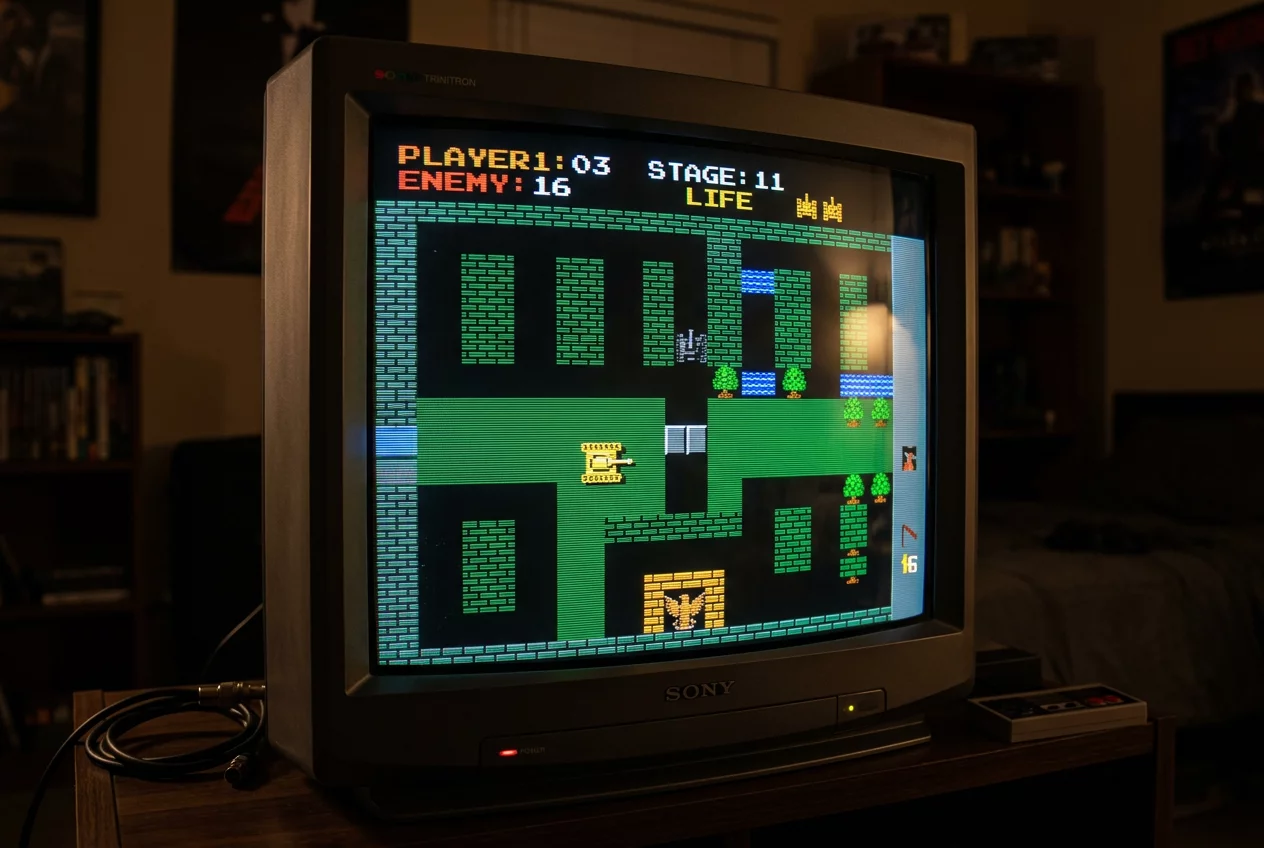
Every Dendy owner in the 90s knew the 1985 classic Battle City. It was more than a game; it was a cornerstone of the post-Soviet console culture. But while most players spent their time defending the eagle and clearing stages 1 through 35, a darker myth began to surface in playgrounds and school hallways regarding the existence of a secret 36th stage and a "God Mode" construction tool that could create steel indestructible bases.
The Legend of Stage 36
According to the rumor that gripped countless 8-bit warriors, finishing the game on the hardest difficulty without losing a single life would unlock a hidden level. This stage allegedly featured a black background with invisible tanks and a base that occupied the center of the screen, requiring the player to navigate a maze of impenetrable steel blocks. Some claimed it was a developer test room, while others whispered it was a crown room where special rewards were unlocked.
Phantom Construct Mode
The construction mode was already a feature of the original game, but the myth proposed a deeper version. Rumors spoke of a button combination pressed at the title screen—Start, Select, and Down held for 10 seconds—that would grant access to the "Engineer's Palette." This mythical editor supposedly allowed players to place power-ups directly on the map or, more famously, create a permanent steel perimeter around the eagle base that no enemy tank could penetrate.
"We tried every cartridge in the neighborhood. One had a blue sticker, the other was just 'Tank 1990'. We believed the blue one had the secret editor, but it just glitched when we got to level 30."
This obsession with "Tank 1990" and other hacks only fueled the fire. These pirated versions often included modified levels and a different selection of power-ups, leading many kids to believe they had finally found the legendary "Custom Maps" version of the game. Digital ghosts or just clever ROM hacks? To many, the search for the ultimate indestructible base remains a core memory of the 8-bit era.
The Editor That Never Was
Battle City was one of the most popular Dendy cartridges in the post-Soviet space, its simple tank-versus-tank gameplay providing hours of cooperative and competitive entertainment. The game shipped with 35 pre-designed stages that cycled indefinitely, but players quickly noticed that the stage layouts followed predictable patterns. This observation led to a powerful assumption: if the stages followed patterns, perhaps they were constructed from a hidden editor that players could access. The myth of a custom map editor became one of the most persistent rumors in the Dendy community, with players across the former Soviet Union trading elaborate theories about how to unlock this phantom design tool.
The specific methods proposed for accessing the editor varied widely. Some players claimed that completing all 35 stages without losing a single life would reveal a secret menu. Others insisted that a specific sequence of button presses at the title screen — variations on the Konami Code theme — would transform the game into a level design suite. More inventive theories suggested that the editor existed only on specific cartridge revisions, leading to a grey market in "editor-enabled" Battle City cartridges that supposedly commanded premium prices in schoolyard trading economies. These trading dynamics gave the myth tangible economic consequences, as children invested real resources in acquiring cartridges that did not exist.
Technical examination of the Battle City ROM reveals no editor data or hidden menu systems. The 35 stages are stored as fixed arrays in the game's code, with each stage represented by a compact grid of tile values. There is no dynamic stage construction system, no unused editor interface graphics, and no code routines that might handle player-created content. The game's simplicity — a direct port of the arcade original — meant that the developers never considered adding features beyond the core tank combat experience. The myth of an editor, while technically impossible, speaks to the creative frustration of players who loved the game's mechanics but craved more content than the 35 repeating stages could provide.
Tank Warfare and Creative Desire
The Battle City editor myth highlights a fundamental tension in 8-bit gaming: the games were often deeper than their content suggested. Battle City's combat mechanics — directional tank movement, projectile ricochets, base defense — supported strategic complexity that the 35 stages could not fully explore. Players who mastered the existing levels naturally sought new challenges, and the absence of official expansion content created a vacuum that myths rushed to fill. The editor represented not just a tool but an entire philosophy of player empowerment, a promise that the community could extend the game beyond its commercial limitations.
The cultural context of Battle City's popularity in Russia also shaped the myth's evolution. Unlike Western players who had access to a steady stream of new NES releases through official channels, Soviet and post-Soviet gamers often owned only a handful of cartridges that they played for years. Battle City was frequently one of these few games, and its repetition made the desire for new content particularly acute. The myth of an editor offered hope that the game's perceived limitations were actually artificial barriers that could be overcome with sufficient knowledge and persistence — a comforting narrative for children who had no other way to obtain new games.
Today, ROM hackers have created actual level editors for Battle City, fulfilling the childhood dream that the original developers never considered. These modern tools allow players to design stages with the same tile-based simplicity as the originals, and online communities share custom campaigns that extend the game's lifespan indefinitely. The existence of these editors retroactively validates the original myth, demonstrating that the playground imagination was directionally correct even when technically inaccurate. Battle City's legacy is thus not just a simple tank game, but a testament to how player creativity can outlast commercial constraints, transforming a limited product into an endless canvas for collective design.
Case Files: Comments
TankCommander
2026-05-01We made our own base out of steel.
Add to the Archive