
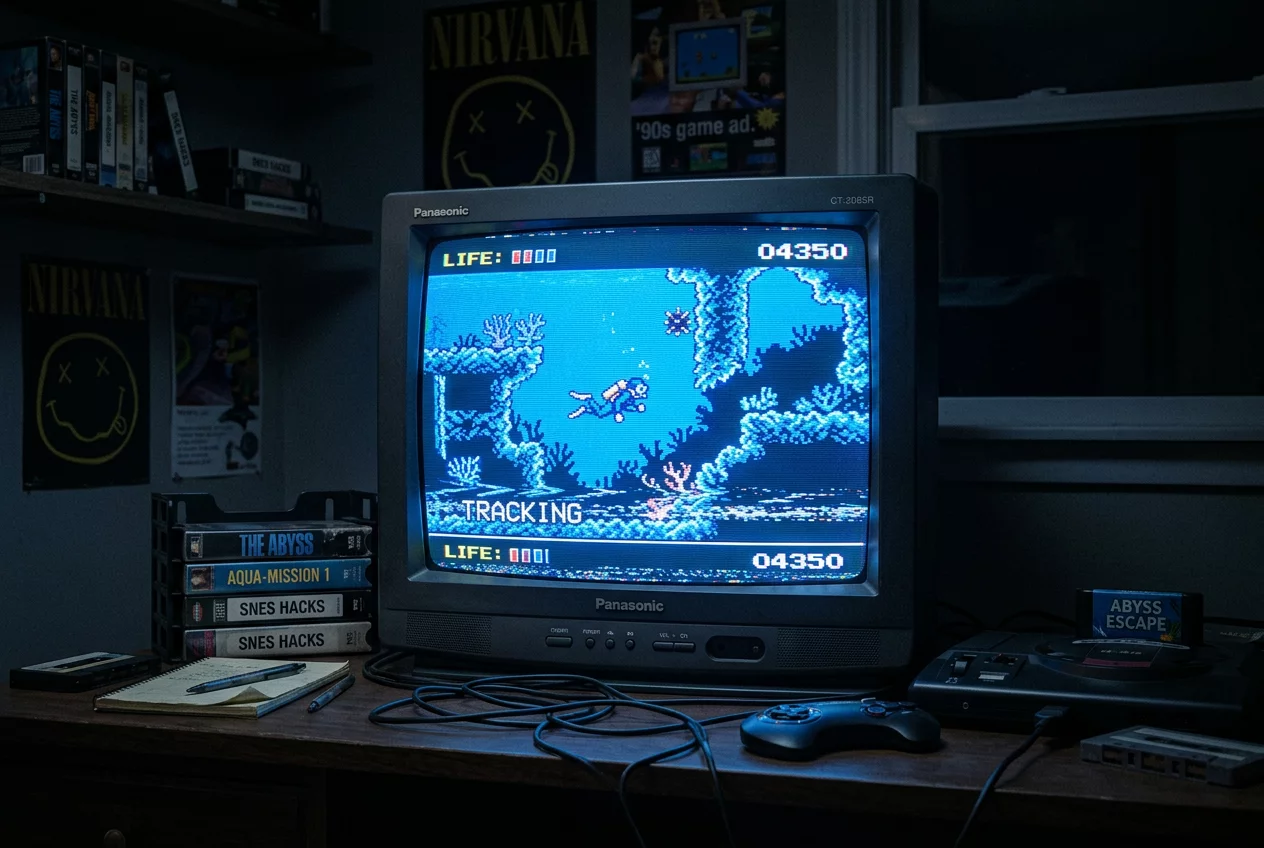
The Ghost in the Machine
In the quiet suburbia of the 1990s, whispered secrets about hidden worlds were the currency of the playground. Among these legends, the 'Minus World' in Super Mario Bros held a special, almost sacred status. It wasn't just a hidden level; it was a mistake that players weren't supposed to see, a glimpse into the raw, unpolished code of the NES and its local clone, the Dendy. This level, formally known as World -1, was a watery abyss that stretched into infinity, trapping any plumber brave or foolish enough to enter its depths.
Breaking the Wall
Accessing this forbidden zone required a precise dance with the game's physics. Near the end of World 1-2, players had to perform a backwards jump while crouching, clipping through the solid bricks of the exit pipe area. This maneuver fooled the game's internal pointers, sending the player to a location in memory that the developers never intended to be accessible. Instead of the warp zone to World 4, the screen would fade and reveal the haunting title: World -1. For a child in the 90s, seeing a negative number on a game screen felt like witnessing a glitch in reality itself.
The Infinite Loop Theory
The Minus World is famously a copy of World 7-2, but with a crucial, terrifying difference: the exit pipe at the end loops the player right back to the start of the level. There is no escape, no flag to capture, and no Princess to save. Legend had it that if you swam long enough or performed a specific sequence of actions, you might find a hidden door to a World -2 or even a final encounter with a shadowy version of Bowser. However, the technical reality is far more somber. The game simply doesn't know where to send you, so it keeps you in a perpetual state of drowning until the timer runs out or you reset the console.
The Legacy of a Glitch
Why does this specific error fascinate us decades later? Perhaps because it represents the era when games were mysterious black boxes. There were no internet wikis to instantly debunk rumors, only the word of a friend whose older cousin supposedly reached the end of the Minus World. It remains a testament to the complexity of early game design, where a single miscalculation in collision detection could birth an urban legend that outlasts the hardware it was played on. The Minus World isn't just a bug; it is a ghost of the 8-bit era, haunting our memories with its endless blue horizon.
The Architecture of a Glitch
Understanding the Minus World requires diving into the technical foundations of the Nintendo Entertainment System and its unlicensed Russian counterpart, the Dendy. The NES used a 6502-derived processor with severely limited memory addressing capabilities. Game worlds were constructed through careful manipulation of memory pointers, and the warp zone in World 1-2 represented a particularly complex sequence of pointer operations. When Mario clips through the wall near the exit pipe, he doesn't simply move to a new location — he triggers a chain reaction in the game's memory management that sends the player to a destination the developers never anticipated.
The specific mechanism involves the game's subroutine for loading new areas. When Mario enters a pipe or reaches a flagpole, the game reads from a lookup table to determine which world to load next. The warp zone pipes are supposed to redirect this lookup to specific entries for Worlds 2, 3, and 4. However, when Mario clips through the wall in the exact location used by the warp zone, the game partially executes the warp zone code without properly setting up all the necessary parameters. The result is a partial memory read that returns the value 0x24, which the game interprets as World 36 — but since the game only has worlds numbered up to 8, the display routine wraps around and shows "-1" instead.
The Dendy version of Super Mario Bros. behaves slightly differently from the official Nintendo cartridge because the Famiclone hardware has minor timing variations in its PPU (Picture Processing Unit). These variations can affect the exact frame windows during which the wall clip is possible, making the glitch either easier or harder to execute depending on the specific Dendy model. Some Russian gamers reported that their consoles required slightly different positioning or button timing, leading to regional variations in the Minus World mythology. These hardware-level differences demonstrate how the same software can generate distinct folklore across different material contexts.
The Social Life of a Software Bug
The Minus World achieved its legendary status not through technical complexity but through social transmission. In the Soviet Union and post-Soviet states, video game information traveled through informal networks that combined elements of oral tradition with the material constraints of scarce technology. Children who discovered the Minus World became local celebrities, their expertise granting them status in hierarchical playground communities. The knowledge of how to access the glitch was sometimes treated as proprietary information, shared only with close friends or traded for other gaming secrets.
The spread of Minus World knowledge was also shaped by the technological limitations of information sharing. Photocopied game magazines, handwritten notes, and word-of-mouth were the primary transmission vectors. Unlike in Western markets where Nintendo Power or Electronic Gaming Monthly could quickly disseminate accurate information, Soviet gamers relied on fragmented and often corrupted information chains. A child who accessed the Minus World through lucky accident might invent elaborate theories about its purpose, and these theories would propagate through the network gaining authority with each retelling. By the time accurate technical explanations became available through internet forums in the late 1990s, the Minus World had already achieved mythological status that no amount of technical debunking could fully dissolve.
Today, the Minus World stands as a monument to a specific historical moment when digital technology was still mysterious enough to support magical thinking. Modern gamers who encounter the glitch through YouTube videos or speedrunning tutorials understand it as a well-documented programming error. But for children in the 1990s, the Minus World was something far more significant — a portal to an alternate dimension, a secret that Nintendo had tried to hide, a proof that the digital world was deeper and stranger than any manual admitted. This transformation from technical bug to cultural myth demonstrates how human communities imbue software with meanings that exceed its designers' intentions, creating stories that persist long after the hardware has become obsolete.
Case Files: Comments
PlumberBro
2026-04-05Got stuck in the water level forever.
Add to the Archive