
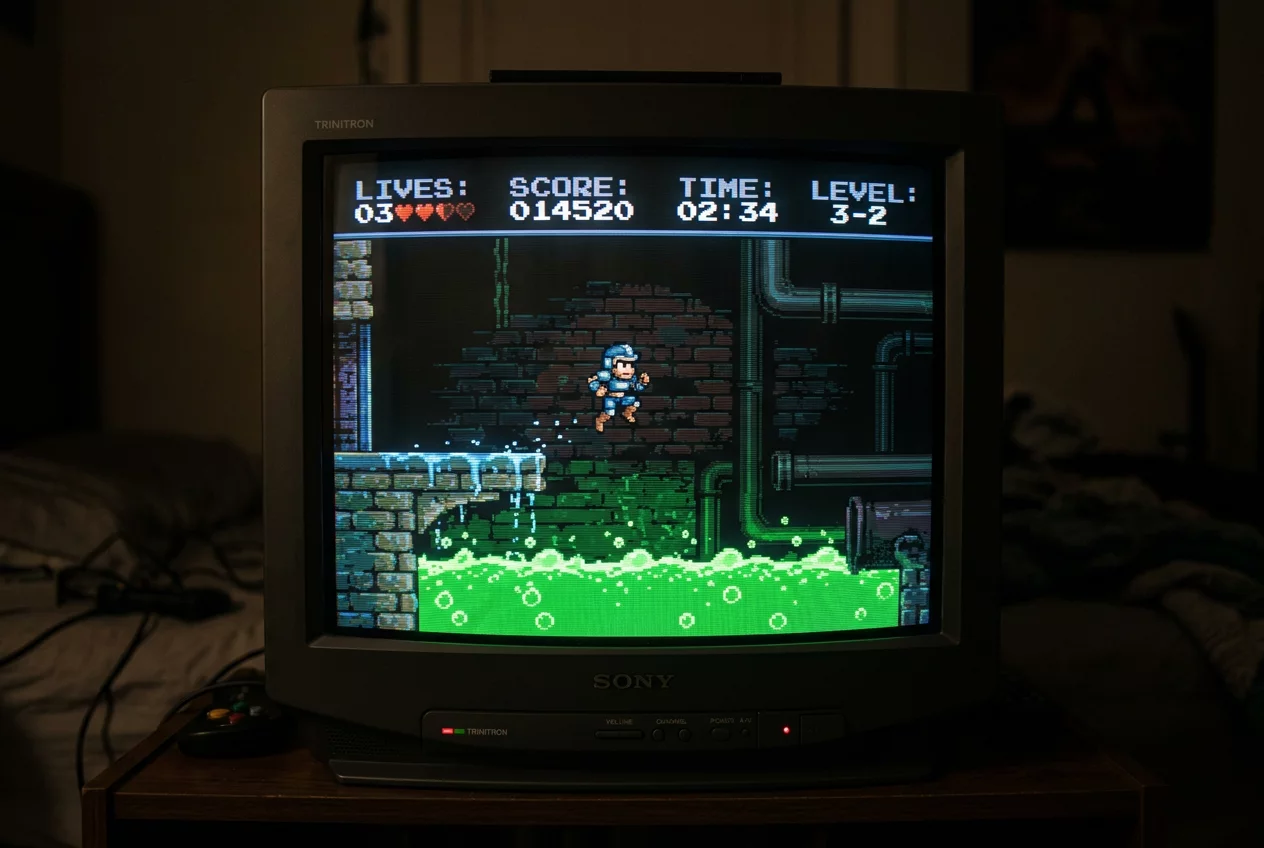
The 1989 Teenage Mutant Ninja Turtles game on the Dendy is legendary for its extreme difficulty, but one specific moment remains etched in the collective memory of gamers as a total dead-end. In Stage 3, the sewer level, players encounter a gap that seems physically impossible to cross. For decades, stories circulated through schoolyards about how this jump was a deliberate block designed to force kids to rent the game longer.
The Ghost of the Pirate Cartridges
One of the most persistent theories suggests that the "impossible jump" was a byproduct of the pirated cartridges that dominated the market. On many Dendy clones, the game's physics were slightly off. This subtle shift in gravity or movement speed meant that while the leap was barely possible on an original NES, it became a literal brick wall on certain bootleg versions. It wasn't just hard; it was mathematically out of reach.
Schoolyard Myths and False Solutions
Because nobody could consistently make the jump, rumors about secret mechanics began to spread. Many players believed that only Donatello could reach the other side if he hit the jump at the exact frame his staff hit the ground. Others swore there was a hidden platform that would appear if you defeated every enemy in the room in a specific order. None of these ever bore fruit, yet the legends persisted online for years.
- The "A+B+Select" myth: A code supposedly granting a triple jump.
- The Screen-Scroll Glitch: A rumor that walking backward would shift the gap.
- The Invisible Block: The belief in a hidden bridge triggered by standing still.
Whether it was a flaw in the porting process or a deliberate hurdle, the sewer jump remains one of the most polarizing moments in 8-bit history. It stands as a testament to an era where games didn't just challenge you; they sometimes seemed to actively work against your progress, sparking a level of mystery that today's polished experiences rarely achieve.
The Geometry of Impossibility
Teenage Mutant Ninja Turtles for the NES is remembered as one of the most brutally difficult games of the 8-bit era, and no single obstacle encapsulates this reputation better than the infamous sewer jump in Stage 3. The gap requires a pixel-perfect leap across a deadly pit while avoiding floating electrified seaweed, a maneuver that seems to demand supernatural timing. For a generation of Dendy players, this jump became a rite of passage and a source of endless frustration, with children across the Soviet Union spending hours attempting to cross a gap that felt deliberately unfair. The difficulty was so extreme that many players concluded the jump must be a puzzle with a hidden solution rather than a straightforward platforming challenge.
The myth of an impossible jump solution took many forms. Some players claimed that Donatello — the turtle with the longest reach — could grab an invisible ledge on the far side if the player held the attack button at the exact apex of the jump. Others theorized that the jump could be bypassed entirely by swimming through a hidden underwater tunnel accessible by pressing Down at a specific point before the gap. The most elaborate version of the myth proposed that the jump required a two-player cooperative technique, with one player throwing the other across the gap using a special throw move that could only be activated when both turtles stood at precise positions on opposite platforms.
Technical analysis of the TMNT ROM reveals that the sewer jump is, in fact, a straightforward platforming challenge with no hidden mechanics. The gap can be crossed by any turtle using a standard jump, provided the player times the button press correctly and approaches from the optimal position. The perception of impossibility arises from the game's notoriously floaty physics, which create a disconnect between player input and on-screen response that makes precise jumps feel random. The electrified seaweed adds visual clutter that distracts from the actual platforming geometry, and the penalty for failure — instant death and a lengthy respawn sequence — creates a psychological barrier that discourages repeated attempts.
Difficulty, Memory, and the Playground Economy
The TMNT impossible jump myth illustrates how game difficulty becomes socially encoded. Children who successfully completed the jump gained significant status in their gaming communities, their achievement serving as proof of exceptional skill. These successful players sometimes embellished their accomplishments by inventing secret techniques or special moves, adding mystique to a challenge that was fundamentally about timing and patience. The myth of hidden solutions thus served a social function: it transformed a difficult but achievable jump into an exclusive club whose membership requirements were known only to the initiated.
The Dendy version of TMNT contributed to the myth's persistence through subtle hardware differences. Famiclone controllers often had less responsive buttons than official NES controllers, making precise jumps genuinely harder on Dendy hardware than on Nintendo's original console. Players who experienced the game on Dendy had a fundamentally different relationship with the jump than players on official hardware, and their complaints about impossibility were grounded in genuine material constraints. This hardware-mediated difficulty created a context where myths about secret solutions felt more plausible than they might have on less demanding platforms.
Modern speedrunners have demonstrated that the sewer jump can be completed with remarkable consistency using optimized techniques, and the gap has become a staple of TMNT speedrunning challenges. These demonstrations have debunked the myth of impossibility while also revealing the depth of skill that the game's designers apparently assumed players would develop. The TMNT sewer jump stands as a monument to an era when game difficulty was not calibrated for accessibility but for the satisfaction of mastery — an era when a single pixel-perfect jump could consume an entire afternoon and generate legends that would persist for decades.
Case Files: Comments
SewerSurfer
2026-05-11That jump ruined my childhood. I spent countless hours trying to find a secret path that didn't exist.
Add to the Archive