
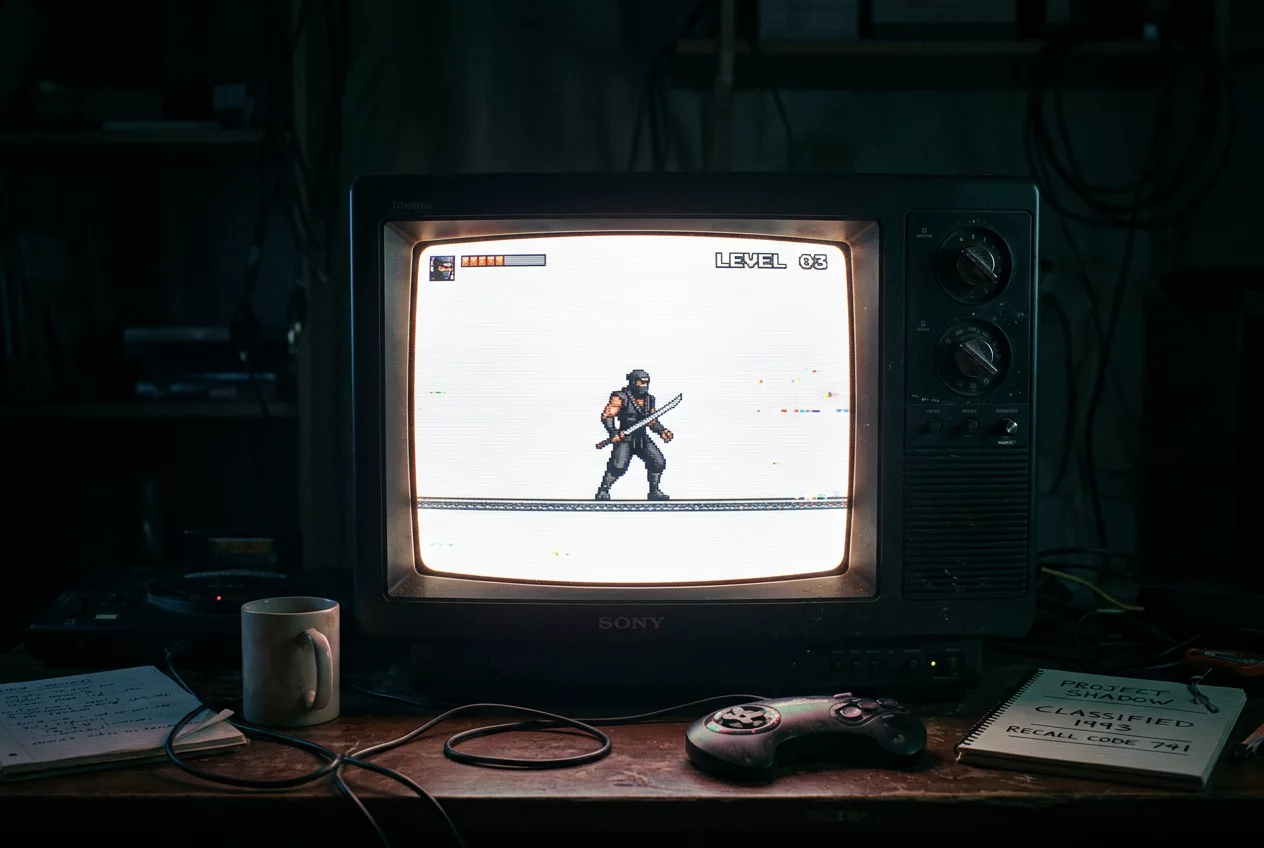
The 16-bit era was a wild frontier of digital ghosts. Among the most enduring legends is the Shinobi III Developer Room. Legend has it that if you perform a specific aerial dance during the high-speed surfboard stage, Joe Musashi would vanish into a glitchy void. This wasn't just a simple system crash; it was rumored to be the gateway to a hidden dimension where the creators of the game resided in digital form.
The Mystery of the Digitized Faces
In the early days of the world wide web, early online communities shared grainy JPEGs of what appeared to be the SEGA development team standing behind glass partitions in a sterile white room. These weren't standard pixel art characters, but digitized real-world photos, which gave the myth a distinctly eerie, "creepypasta" feel long before that term became a common part of our lexicon. Some players claimed you could even hear a distorted, lo-fi recording of "Thank you for playing" in Japanese if Joe stood perfectly still for exactly five minutes.
The technical details shared in various schoolyards suggested that the room was a debug leftover that the team at Sega CS forgot to wipe before the cartridge went to master. This room became the crown jewel of unverified Sega lore, often cited alongside the Sonic 2 hidden levels and the Mortal Kombat red ninja glitches.
Code Analysis and Cold Reality
Modern ROM hackers have scoured every sector of the game cartridge. While they have found unused sprites, experimental sound test entries, and even remnants of a scrapped level involving a blizzard, no actual "Developer Room" has ever been officially triggered via traditional gameplay. It exists as a phantom within the memory—a collective hallucination or perhaps a very clever prank played by a few early hackers on the rest of the community.
Regardless of its physical existence in the hex code, the story persists. It represents a time when we truly believed that games held secrets deeper than what was printed in the glossy pages of the instruction manual. The mystery of the digitized faces remains locked within the silicon, a ghost in the machine that still sparks late-night debate among retro enthusiasts and archive hunters today.
The Shadow Warriors of Development
Shinobi III was the culmination of everything Sega had learned about ninja-themed action games across the 8-bit and 16-bit eras. The game pushed the Mega Drive's hardware to its limits with multi-layered parallax scrolling, massive boss sprites, and a soundtrack that many consider among the best on the console. This technical excellence created an environment where players naturally assumed that the developers had hidden additional content throughout the cartridge — secret rooms, debug modes, and messages from the creators that could only be accessed through precise, almost mystical input sequences.
The developer room myth specifically claimed that the game's designers had hidden a personal message accessible by completing the entire game without using shurikens, taking damage, or continuing. According to the legend, players who achieved this impossible feat would be transported to a black room where the names of the development team scrolled across the screen in golden characters. The room allegedly contained concept art for unreleased levels and a personal letter from the director thanking dedicated players for their commitment to mastering the game. While no such room exists in the final ROM, the myth was plausible because Shinobi III did contain debug coordinates and unused stage data that hackers would later discover.
The technical reality of Shinobi III reveals a development process that was far more chaotic than the polished final product suggests. Internal documents from Sega of Japan show that the game underwent multiple revisions, with entire stages being redesigned and enemy patterns being rebalanced up until the final mastering phase. The presence of unused assets in the ROM — including sprites for enemies that never appear and background layers for stages that were cut — provided concrete evidence that the game had once contained more content than the retail version allowed. These findings validated the broader community belief that Shinobi III was a truncated masterpiece, with its full potential locked away behind development deadlines and cartridge space limitations.
Ninja Mythology in the Playground Era
The 1990s represented the peak of ninja fascination in Western popular culture, and Shinobi III arrived at precisely the moment when this interest intersected with affordable home console gaming. Children who had grown up on cartoon ninjas and martial arts films found in Shinobi III a game that seemed to understand their aesthetic priorities. The myth of a developer room tapped into this cultural moment by suggesting that the game's creators were themselves ninja masters who had left hidden messages for worthy disciples. This framing transformed a technical curiosity into a spiritual quest, elevating the act of playing Shinobi III into something that felt like genuine ninja training.
The difficulty of Shinobi III was itself a factor in the myth's persistence. The game demanded pixel-perfect platforming, memorization of enemy patterns, and conservation of limited resources. Most players never completed the game, and those who did typically used continues and power-ups liberally. The requirement to complete the game under extreme restrictions meant that almost no one could personally verify or debunk the developer room claim. This verification gap allowed the myth to persist for years, with each new generation of players discovering the rumor through magazines and playground conversations rather than direct experience.
Modern speedrunners and ROM hackers have thoroughly mapped Shinobi III's memory, confirming the absence of a developer room but also documenting the extensive unused content that makes the myth feel almost prophetic. The game's designers did leave messages for players, but they encoded them in the level architecture, the enemy placements, and the intricate scoring system rather than in a hidden room. The true developer "message" in Shinobi III is the game itself — a meticulously crafted action experience that represents hundreds of hours of dedicated craftsmanship. The myth of a secret room, while factually incorrect, honors this dedication by imagining a space where the creators could personally thank the players who appreciated their work most deeply.
Case Files: Comments
NinjaStar
2026-05-17I saw screenshots in a magazine once. It looked so real that I spent my whole summer trying to find it.
Add to the Archive