
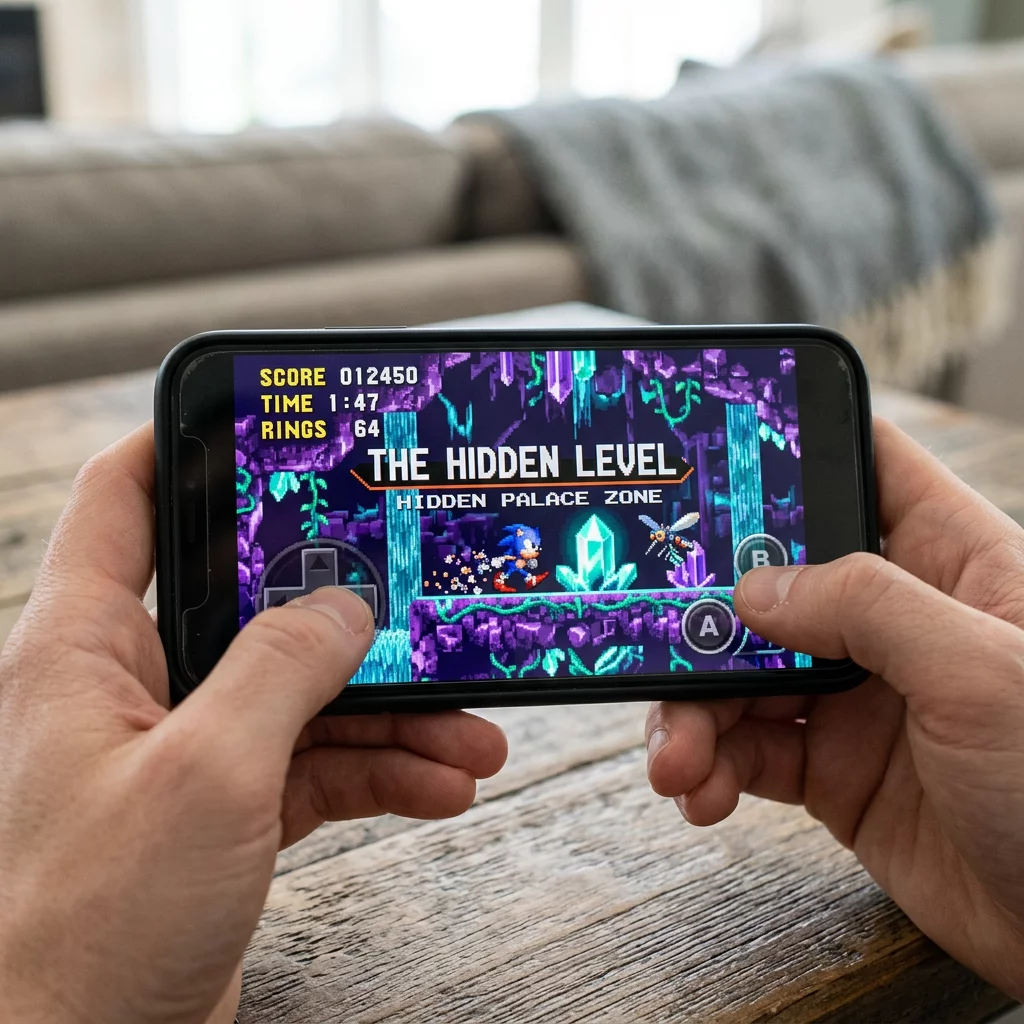
Every kid with a Sega Mega Drive in the early 90s heard the rumor. It usually started with a cousin's friend or a mysterious magazine scan found in the back of a shop. They spoke of a glowing underground world filled with purple crystals and Master Emeralds. This wasn't just another stage; it was the Hidden Palace Zone, a legendary level that exists within the code of Sonic the Hedgehog 2 but was famously cut before the game reached the shelves.
The Ghost in the Code
For years, players spent hours looking for a way to enter this digital phantom. Some swore that jumping into a specific pit in Mystic Cave Zone would transport you there. Others believed a complex button code at the title screen would unlock the crown jewel of secret levels. While the retail cartridge didn't allow natural access, the level's data remained buried in the ROM, waiting to be unearthed by hackers and data miners.
When enthusiasts eventually accessed the level through Pro Action Replay codes, they found a beautiful, unfinished wasteland. The purple glowing gems and unique assets made it feel like a fragment from an alternate reality. It was a place where Sonic became a ghost, falling through platforms that weren't fully programmed. The mystery of why it was removed became as big as the level itself, with theories ranging from time constraints to hardware limitations.
Urban Legends and Digital Myths
Before the internet made finding information easy, these myths were the lifeblood of gaming culture. You couldn't just check an online database to debunk a rumor. You had to play, experiment, and share stories. The Hidden Palace Zone represents the peak of this era — a time when games felt like massive, unexplored worlds containing secrets that might never be found. It remains a symbol of the creative chaos that defined the 16-bit development era.
- The level featured distinct music that later appeared in other franchise entries.
- Early prototypes revealed it was originally intended to be a single-act zone.
- A massive emerald object was found in the stage, fueling rumors about Super Sonic's origins.
- Some modern remasters have finally officially included the stage as a tribute.
Development Archives and Cut Content
Every kid with a Sega Mega Drive in the early 90s heard the rumor. It usually started with a cousin's friend or a mysterious magazine scan found in the back of a shop. They spoke of a glowing underground world filled with purple crystals and Master Emeralds. This wasn't just another stage; it was the Hidden Palace Zone, a legendary level that exists within the code of Sonic the Hedgehog 2 but was famously cut before the game reached the shelves.
For years, players spent hours looking for a way to enter this digital phantom. Some swore that jumping into a specific pit in Mystic Cave Zone would transport you there. Others believed a complex button code at the title screen would unlock the crown jewel of secret levels. While the retail cartridge didn't allow natural access, the level's data remained buried in the ROM, waiting to be unearthed by hackers and data miners.
When enthusiasts eventually accessed the level through Pro Action Replay codes, they found a beautiful, unfinished wasteland. The purple glowing gems and unique assets made it feel like a fragment from an alternate reality. It was a place where Sonic became a ghost, falling through platforms that weren't fully programmed. The mystery of why it was removed became as big as the level itself, with theories ranging from time constraints to hardware limitations.
Urban Legends and Digital Myths
Before the internet made finding information easy, these myths were the lifeblood of gaming culture. You couldn't just check an online database to debunk a rumor. You had to play, experiment, and share stories. The Hidden Palace Zone represents the peak of this era — a time when games felt like massive, unexplored worlds containing secrets that might never be found. It remains a symbol of the creative chaos that defined the 16-bit development era.
Before the internet democratized information, the Hidden Palace Zone existed in a peculiar limbo between fact and fiction. Magazine articles from the early 90s occasionally referenced mysterious zones that testers had glimpsed, fueling playground rumors across multiple continents. In Brazil, where the Tec Toy distributed Mega Drive dominated the market, children spoke of a "Zona do Cristal" that could only be reached by collecting every ring in the game without taking damage. Japanese magazines published blurry screenshots that might have shown early builds, but the language barrier prevented Western audiences from verifying these claims.
The myth persisted because Sonic 2 itself contained tantalizing hints. The title screen showed Sonic running through a zone with architecture that never appeared in the final game. The sound test contained a track labeled "HPZ" that players could access through debug codes. These fragments of evidence made Hidden Palace feel less like a rumor and more like a locked door waiting for the right key. When the zone was finally revealed in its raw form, it validated an entire generation of speculation and proved that the most elaborate playground myths sometimes contained kernels of truth.
Today, Hidden Palace stands as a monument to the creative constraints of the 16-bit era. It represents the art that exists in the negative space of commercial products — the levels that were designed, built, and then abandoned due to circumstances beyond the developers' control. Modern preservation efforts have restored the zone to playable condition, but the original ROM remains the most authentic experience. There is something uniquely powerful about accessing a space that was never meant to be seen, a digital ruin preserved in silicon that continues to inspire fascination three decades after its creation.
Case Files: Comments
RetroFan99
2026-04-10I remember hearing about this in the schoolyard! Everyone said you had to beat the game without collecting a single ring to see it.
Add to the Archive